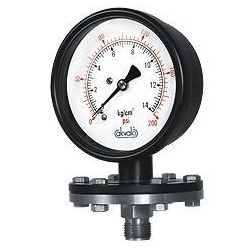
About Diaphragm Gauges
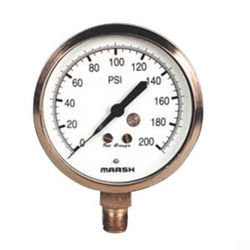
Specifications:- Nominal Size (mm): 100, 150
- Scale Range: 0..to 6000 mmWC Low Pressure & 0..to 0.6 to 25 kg/cm2 High Pressure
- Accuracy in FSD: 1.6%
- Thread Connection: 3/8", ", BSP & NPT, M-20 and Flanged connection
- Mounting of Gauge: Direct Bottom
- Case and Bezel: Drawn steel, SS 304
- Pressure Elements: Schaffers Diaphragm
- Diaphragm: Yes
- Wetted Parts: Spring Steel Teflon Coated, SS 304, SS 316 and other material on request
- Application: Chemical & Petrochemical, Food & Beverage Industry, Mechanical Engineering Plant & Apparatus Construction
Built for Demanding ConditionsManufactured to IS/EN standards, these precision-engineered diaphragm gauges excel in harsh industrial environments. Their IP65-rated casing resists dust and weather, making them suitable for both indoor and outdoor installations. Materials like stainless steel and brass ensure longevity and reliability under continuous use, even with fluctuating pressures and temperatures.
Flexible Installation OptionsTo support varied installation needs, these gauges come with multiple mounting types, including flange upon request, and connection options of 1/2 BSP (male/female) or as per specific requirements. Sizes are available in standard 100 mm, as well as 63 mm and 150 mm diameters, accommodating different panel or process layouts. Accessories such as mounting brackets further simplify integration into your system.
Precision and Safety FeaturesWith an accuracy of 1.6% FSD and customization across scale ranges, each gauge delivers dependable readings. Key safety and usability attributes include external/internal zero adjustment, overload stops, neoprene/PTFE/Viton seals, and an easily readable analog display through a clear glass or acrylic window. These features collectively ensure both accurate monitoring and operational safety.
FAQ's of Diaphragm Gauges:
Q: How do diaphragm gauges operate without a Bourdon tube?
A: Diaphragm gauges use a flexible diaphragm as the sensing element instead of a Bourdon tube. Pressure applied to the diaphragm deflects it, and this deflection is translated into pointer movement on the analog display, offering accurate readings for liquid, gas, or vapour.
Q: What materials are used in the construction of these gauges and why do they matter?
A: The gauges are constructed from industrial-grade stainless steel or brass for connections and movement components, with a clear toughened glass or acrylic window and polished or matte finishes. These materials ensure durability, corrosion resistance, and optimal performance in harsh environments.
Q: When should I choose a weatherproof or dustproof casing for diaphragm gauges?
A: You should opt for IP65-rated weatherproof or dustproof casing when the gauge will be installed in environments exposed to dust, moisture, or outdoor elements, as this protection prolongs the gauge's life and ensures measurement integrity.
Q: Where can these diaphragm gauges be installed?
A: These gauges offer versatile mounting-bottom entry, back entry, or direct mount-making them suitable for various application points in industrial facilities wherever liquid, gas, or vapour pressure (non-crystallizing, non-corrosive) measurement is necessary.
Q: What are the benefits of zero adjustment and overload stop features?
A: Zero adjustment-external or internal-allows precise calibration, maintaining accuracy over time. The overload stop prevents damage from sudden pressure spikes, ensuring the gauge's longevity and reliability in critical processes.
Q: How do I select the appropriate scale range and connection for my application?
A: Choose the scale range based on the maximum expected system pressure (up to 25 kg/cm2, or custom). Select the connection material (brass or SS304/SS316) and thread size (1/2 BSP or as required) considering the process medium and installation requirements to ensure safe and compatible operation.


 Send Inquiry



 Send Inquiry